|
Reflection of waves consists of a change of direction of the wavefront when it meets an obstacle.
Refraction consists of the change of speed of propagation and direction which is produced when an undulatory movement changes medium.
These phenomena respect the following norms:
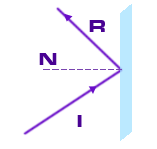 |
In reflection, the direction of the incident wavefront I, forms with the normal N at the surface of the obstacle, an angle equal to that formed by N with the reflected wavefront R |
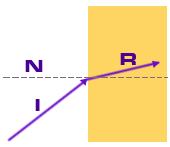 |
In refraction, when changing medium, the direction of the incident wavefront I is deviated so that, if the velocity of the waves in the second medium is lower than in the first the direction of the refracted wavefront R approaches the normal N. If the velocity of propagation were greater in the second medium R would distance itself from the normal N. | |