|
-
The atoms of bodies possess positively
charged heavy particles, protons, and negatively charged light
particles, electrons. The excess of electrons means that the
body is negatively charged and the deficit of electrons means that the
body is positively charged.
-
In some bodies the charge is forced to
remain almost immobile, these are insulators, while
in other bodies it can move freely, these are conductors.
-
Bodies with charges of the
opposite sign attract each other, while bodies with charges of the same
sign repel each other.
-
The value of the force of attraction or
repulsion between two particles is explained by Coulomb's Law:
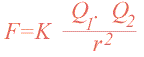
where Q1 and Q2 are the values of the charges which
are interacting, r is the distance between the particles, and K is the
dielectric constant which depends on the medium. For a vacuum:
- When two or more charged particles act on
another, the force exerted by each one is independent of that exerted
by the others (principle of superposition). The total
force is obtained from the vectorial sum of each one of the particular
forces.
|