Mathematical calculation
of equilibrium
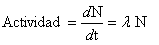
The activity depends on the type of material ( l
) and the number of atoms in the radioactive isotope.
Let's imagine that X is the first element in a series. At the start there are
only atoms of this element.
The X atoms transmute into Y and are accompanied by radiation. The Y in turn
transmute into Z.
Let's suppose that the T½ of X is three days ( a very high
l, many atoms are transformed per second) and the
period of Y, T' ½, is very large (few atoms become Z per second).
Initially the activity of X is very high, but decreases as the number of atoms
decreases. The activity of Y increases as more and more atoms are formed.
When only Nx atoms of X are left radioactive equilibrium is reached: the number
of Y atoms which trasmute per second is equal to the number which are formed
(which transmute from X). The activity of the two are the same.
As Y transmutes into Z and the chain continues we can apply the same reasoning:
To reach a state of equilibrium time must pass since the first element of the
series began to decay.
The value of the activity of the sample and the activity of each stage decrease
with time.
This law of equilibrium can be used to find the quantity of any isotope in the
series providing that we know its radioactive constant and the quantity of another
element of the series and its radioactive constant (three values of the four
in the equation)
The comparison with a waterfall passing through
several tanks with outlets of different diameters helps to explain the ideas
presented above.
When equilibrium is reached the activity at each stage is the same. The stage
in which l is large (short half life), the N is small.
If l is small N will be large.
In the comparison with the waterfall, when the outlet is large,
the height of the water in the tank is small, and with a small outlet, the height
will be great.
The activity of the isotopes which form in all the stages of the
series add up their effects.
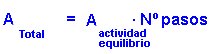
The decay per second, once equilibrium is reached, is equal in each stage and
the total activity is: