
Conservation of momentum in beta decay
In radioactive processes the emission of particles obeys the principle of conservation of momentum: the momentum of the atom before transmutation is equal to the momentum of the particles and atoms which are originated.
When conservation of momentum was studied it was found that the principle was not obeyed, so W. Pauling postulated in 1930 the existence of another particle called a neutrino n – an elusive particle with a resting mass of zero -. The neutrino was identified in a reaction in 1958.
The antineutrino, a particle of anitmatter appears in the emission of beta radiation.
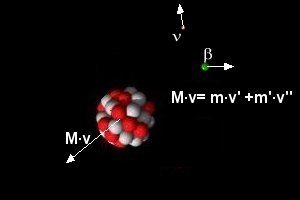
By introducing this particle in the calculations, the principle of conservation of momentum is obeyed.
If we assume that the initial atom is still, the momentum before transmutation will be zero.
The beta particle is emitted in one direction and the neutrino and the element formed in the other.
The sum of the momentum will be zero. Addition of the vectors gives zero (they neutralize each other).
p = momentum = mass · velocity
P Before = PAfter
pA= 0
0 = M·v'-m·v
M·v' = m·v