
 |
 |
 |
|
 |
All teaching units |  |
 |
Home | |
|
1.4
Conclusions about linear momentum and impulse |
||||||
|
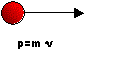
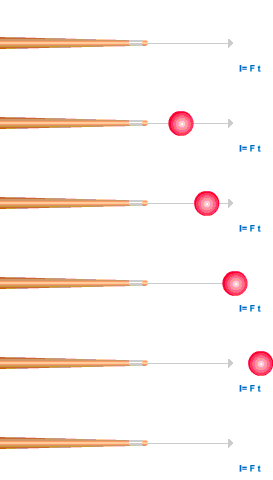
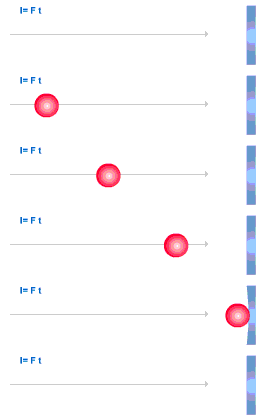
We call the magnitude that measures the capacity that a body has to produce an effect on other bodies in a collision linear momentum. We call the variation of linear momentum impulse. When we increase the linear momentum of a body, it is receiving a positive impulse; when we diminish its linear momentum, the impulse is negative.
Principle of conservation of linear momentum: When a particle system does not receive an external impulse, its total linear momentum remains constant.
|
 |
 |
 |
 |
Linear momentum and impulse | |
 |
 |
 |
|
What is linear momentum? | |
|
What is impulse? | |
|
Conservation of linear momentum | |
|
Conclusions | |